
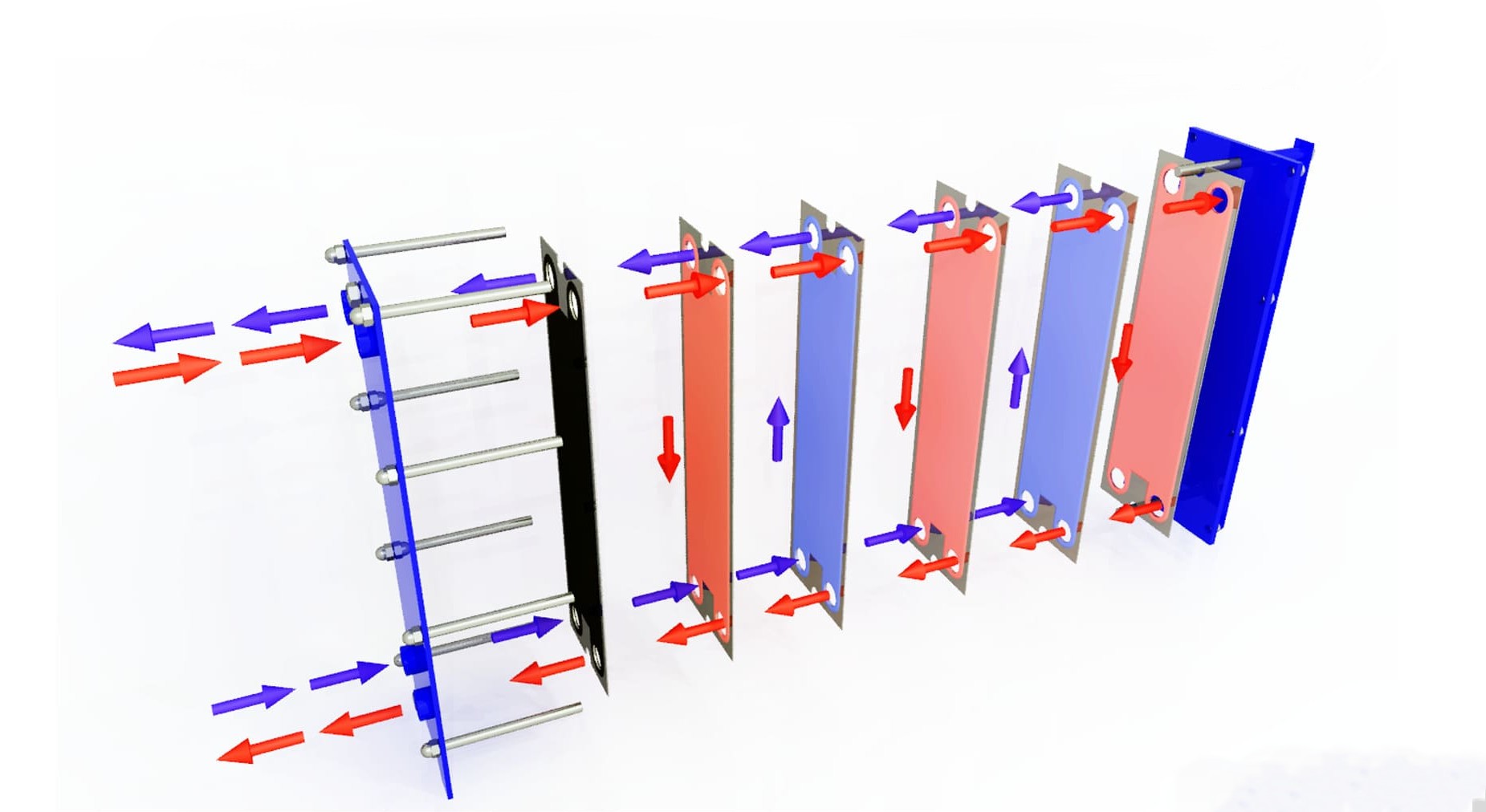
The flow arrangement in a Gasketed Plate Heat Exchanger (GPHE) plays a crucial role in determining its thermal efficiency, pressure drop, and overall performance. Unlike traditional shell-and-tube exchangers, GPHEs consist of multiple thin, corrugated plates arranged in a frame, with gaskets directing fluids through alternate channels. Depending on process requirements, the fluids can be arranged in parallel flow, counterflow, or crossflow configurations, each offering unique advantages for specific applications. Among these, counterflow arrangement is the most common and efficient, as it allows for maximum temperature difference between the hot and cold streams, ensuring better heat recovery and energy savings.
In a parallel flow arrangement, both fluids move in the same direction. While this configuration is simpler, it is less efficient compared to counterflow because the temperature difference decreases along the flow path. However, it is sometimes used where gentle temperature changes are necessary to avoid thermal stress on sensitive equipment. The crossflow arrangement is less common but can be applied in certain systems requiring compact design and moderate thermal performance. By adjusting the number of passes on either side, GPHEs can be designed to achieve the desired thermal duty and balance between efficiency and pressure drop.
The choice of flow arrangement directly impacts the heat exchanger’s effectiveness in industries such as HVAC, chemical processing, food & beverage, power plants, and pharmaceuticals. For example, counterflow arrangements are widely used in process cooling and heating systems where maximum energy recovery is needed, while parallel flow may be chosen for temperature-sensitive processes. By understanding the flow arrangement, operators can select the right GPHE configuration to achieve optimal results, reduce energy consumption, and extend the lifespan of the equipment.