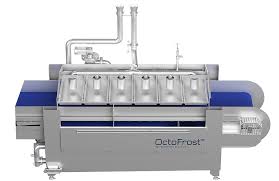
Master the Chill: The Ultimate Guide to Tunnel Cooling Chillers
In high-volume food processing and industrial manufacturing, heat is the enemy of efficiency and safety. Tunnel cooling chillers are the heavy hitters of the thermal management world, designed to bring temperatures down rapidly and consistently.
Whether you are looking to preserve the crispness of a vegetable or ensure the structural integrity of a molded plastic part, understanding how these systems work is key to optimizing your production line.
What is a Tunnel Cooling Chiller?
A tunnel cooling chiller is a specialized industrial refrigeration system where products travel through a temperature-controlled enclosure (the “tunnel”) on a conveyor belt. Unlike batch cooling, which requires stopping the line, tunnel chillers provide continuous, high-speed heat extraction.
How It Works: The Science of the “Flash Chill”
Tunnel chillers utilize various methods to strip heat away from products as they move:
- Convection Cooling: High-velocity fans circulate chilled air over the product surface.
- Heat Exchange: The system uses a refrigeration cycle to keep the air or water at a precise set point.
- Evaporative Cooling (Optional): In some setups, a fine mist is applied to use the power of evaporation for even faster cooling.
Key Formula: The efficiency of a cooling tunnel is often determined by the heat transfer rate, represented by:
$$Q = h \cdot A \cdot \Delta T$$
Where $Q$ is the heat transfer, $h$ is the heat transfer coefficient, $A$ is the surface area, and $\Delta T$ is the temperature difference.
Core Benefits for Your Production Line
- Increased Throughput: Continuous flow means no bottlenecks. You can move products directly from the oven or mold to packaging.
- Product Quality & Safety: Rapid cooling inhibits bacterial growth in food and prevents warping or “sinking” in manufactured parts.
- Energy Efficiency: Modern chillers feature Variable Frequency Drives (VFDs) and high-efficiency compressors that scale power usage based on the load.
- Space Optimization: By utilizing vertical space or specialized belt configurations (like spiral tunnels), you can achieve massive cooling capacity in a compact footprint.
Common Applications
| Industry | Typical Use Case |
| Food & Beverage | Cooling baked goods, poultry, dairy, and ready-to-eat meals. |
| Pharmaceuticals | Stabilizing temperature-sensitive medications and vaccines. |
| Plastics & Rubber | Setting molds and cooling extruded profiles to prevent deformation. |
| Chemical Processing | Maintaining precise temperatures during exothermic reactions. |
Choosing the Right System: What to Look For
When sourcing a tunnel cooling chiller, keep these SEO-friendly “must-haves” in mind:
- Hygienic Design: For food applications, look for stainless steel construction and “wash-down” ratings.
- Modular Construction: Can the tunnel be expanded if your production grows?
- Smart Controls: Look for PLC-integrated systems that allow for remote monitoring and data logging.
- Eco-Friendly Refrigerants: Ensure the system uses modern, low-GWP (Global Warming Potential) refrigerants to stay compliant with environmental regulations.
Keep Your Operation Running Cool
Investing in a high-quality tunnel cooling chiller isn’t just about lowering temperatures—it’s about raising your bottom line. By reducing waste, improving cycle times, and ensuring consistent quality, these systems pay for themselves in no time.
Ready to upgrade your cooling process? Contact a thermal management specialist today to custom-engineer a solution for your specific workflow.